A recent market report on Encino contained a contradiction that should stop any serious buyer mid-scroll. In July 2026, the average sale price in the neighborhood jumped 35.7 percent year over year to $2.1 million. In that same window, the median price per square foot fell 20.2 percent. Same neighborhood, same report, two numbers moving in opposite directions.
That is not a typo and it is not noise. It is the clearest sign yet that "the median home price in Encino" has stopped being a single, useful number. And once you understand why, comparing Encino to its neighbor across the freeway, Sherman Oaks, starts to look very different than a side-by-side portal search suggests.
Two numbers, one report, no error
Here is the mechanism. Price per square foot is a size-adjusted number. Total sale price is not. When a market's closed sales shift toward larger homes on larger lots, average total price rises even if those bigger homes are selling for less per square foot than the smaller, updated homes that closed the year before. Big houses routinely carry a lower price per square foot than mid-size, fully renovated ones, even when their total price tag is much higher.
So a 35.7 percent jump in average price alongside a 20.2 percent drop in price per square foot is not two contradictory signals. It is one signal: the mix of what sold in Encino changed. More of the closings that month were large estate-tier properties, and fewer were the smaller, dialed-in homes that drive price per square foot upward. The average moved because the inventory that changed hands moved. That is a composition effect, not a valuation trend, and it is exactly the kind of thing a headline median hides.
The split Encino doesn't show you
Encino is not one market wearing one zip code. It is two.
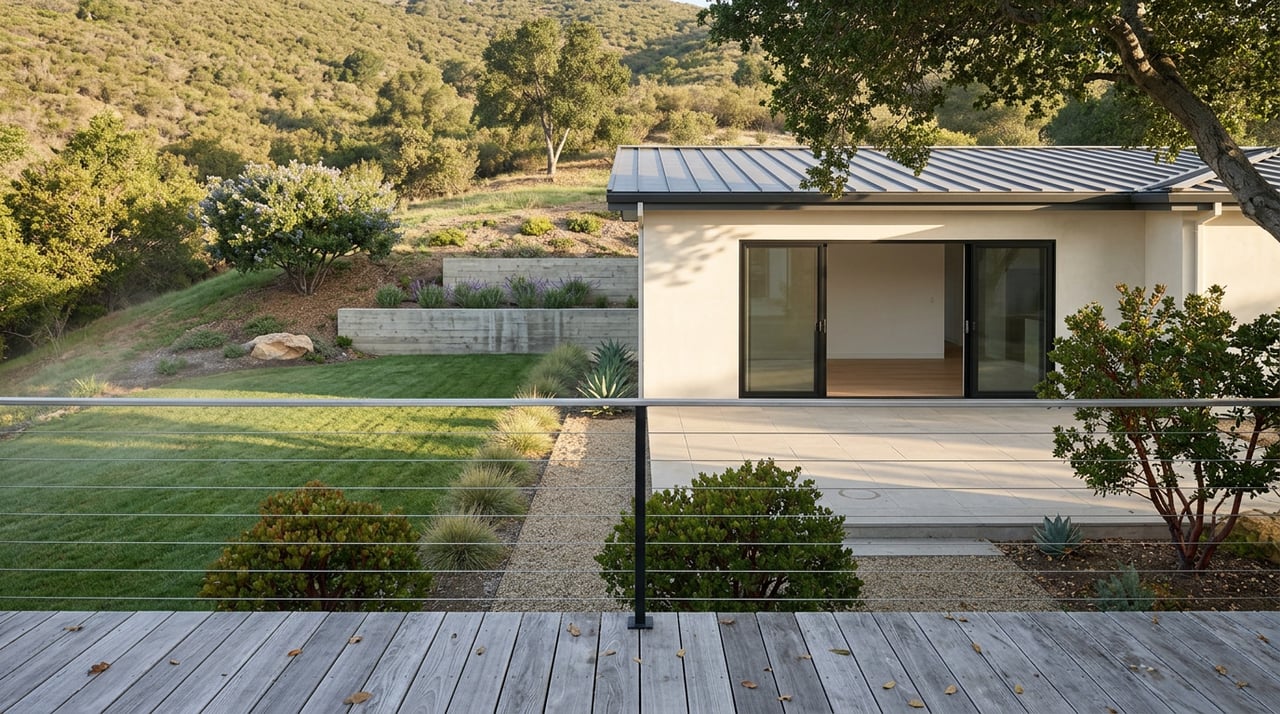
The flats, largely in 91316, are running roughly $800,000 to $1.4 million as of May 2026. The hills and the streets south of Ventura Boulevard, concentrated in 91436, are a different animal entirely: $1.5 million to $5 million or more, with estate-scale lots reaching $8 million-plus. One listing spotted earlier this year was a nearly 1.55-acre Encino Hills parcel, once owned by a Hollywood producer, first on the market in 30 years. That is not a comp for a 1960s ranch in the flats, but a neighborhood-wide median blends them into one figure anyway.
This is why market reports published just weeks apart in 2026 have quoted Encino medians ranging from $1.3 million to $3.14 million. Every one of those numbers is defensible on its own terms. None of them is wrong exactly. But none of them, standing alone, tells a buyer what a specific type of home in a specific part of Encino actually costs, because the underlying pool being averaged keeps shifting depending on which few estate sales closed during the reporting window.
Sherman Oaks has a similar geography, a hills section south of Ventura and a flatter grid to the north, with the south side commanding a premium of roughly 15 to 20 percent. But the reported medians for Sherman Oaks in 2026 cluster far more tightly: figures in the $1.35 million to $1.68 million range show up again and again across sources, with price per square foot consistently landing between $700 and $740. The reason is scale. Sherman Oaks' hillside inventory is mostly updated mid-century and ranch stock, not multi-acre estate parcels. There is no equivalent to the $8 million Encino Hills outlier pulling the tail of the distribution. Fewer extreme values means a median that actually behaves like a median.
What the numbers look like side by side
| Metric (2026) | Encino | Sherman Oaks |
|---|---|---|
| Flats/north-of-Ventura range | $800K – $1.4M (91316) | Lower end starts near $1.1M for smaller, original-condition homes |
| Hills/south-of-Ventura range | $1.5M – $5M+, estate lots to $8M+ | $2.2M+ in the hills, premium pockets south of Ventura between Kester and Coldwater |
| Price per square foot | Reported between $555 and $826 depending on source and window | Consistently reported between $700 and $740 |
| Active single-family listings, summer 2026 | Fewer than 60 | Roughly 150 to 155 |
| Days on market trend | Stretched from about 18 days in early 2025 to roughly 28 days this summer for the split tiers, with neighborhood-wide averages running as high as 80 days | Well-priced homes moving in 25 to 40 days, premium pockets in 14 to 21 days |
The inventory line matters as much as the price ranges. Encino has fewer than 60 active single-family listings this summer against Sherman Oaks' roughly 150 to 155. That gap alone changes how a buyer should behave in each market. With so few homes to compare against in Encino, a single unusual closing, a compound sale, a distressed estate, a rushed relocation, can swing the reported median or average noticeably. Sherman Oaks' deeper inventory absorbs those one-off sales without moving the needle nearly as much.
Why this matters if you're comparing the two
If you are cross-shopping Encino and Sherman Oaks off portal medians alone, you are comparing a number that is genuinely stable to one that is not, and treating them as equivalent.
A few practical adjustments make the comparison useful again:
- Ask for tier-specific comps, not neighborhood-wide medians. In Encino, that means comps pulled separately for 91316 flats and 91436 hills, not blended together. In Sherman Oaks, it means comps split by north and south of Ventura.
- Weight price per square foot over total price when the properties differ meaningfully in size. A $3 million home on a half-acre and a $3 million home on a standard lot are not the same purchase, even at an identical price tag.
- Treat a single month's median with more caution in a thin market. Encino's sub-60-listing inventory means one or two estate sales can move the average significantly. Sherman Oaks' deeper pool is more resistant to that kind of distortion.
- Read days-on-market trends as a signal about negotiating room, not just speed. Encino's stretch from about 18 to roughly 28 days points to buyers gaining leverage faster there than in Sherman Oaks, where well-priced homes are still moving inside a 25 to 40 day window.
None of this means one neighborhood is a better buy than the other. It means the two markets require different reading strategies. Encino's bifurcation makes a single median close to meaningless without knowing which side of Ventura, and which zip code, a given number came from. Sherman Oaks' more continuous inventory makes its median a genuinely useful shorthand, at least as a starting point before you get into hills versus flats specifics.
A few questions worth asking before you compare further
Why do so many 2026 reports disagree on Encino's median price? Because Encino's market is genuinely bifurcated between the 91316 flats and the 91436 hills and south-of-Ventura tier, and different reports capture different slices of closed sales during different windows. A month with a few extra estate-tier closings will push an average or median noticeably higher than a month without them.
Does Sherman Oaks have the same north-south split? Yes, homes south of Ventura Boulevard command a premium in the range of 15 to 20 percent over comparable homes to the north. The difference is scale: Sherman Oaks' premium tier is mostly updated mid-century and ranch homes, without the multi-acre estate outliers that make Encino's hills tier so much more volatile.
Is thinner inventory in Encino a problem for buyers? It changes strategy more than it creates a problem. With fewer than 60 active single-family listings this summer, buyers have less to compare against directly, which makes tier-specific comps and a close reading of recent closed sales more important than they would be in a deeper market like Sherman Oaks.
Numbers like these only tell you something once you know which slice of the market they came from. That is the work worth doing before you commit to a neighborhood, a budget, or an offer.
If you are weighing Encino against Sherman Oaks, or trying to figure out what a specific budget actually buys in either one, Shalaya Shipman can pull the tier-specific comps that a blended median will never show you. Get your free home valuation and start the comparison with numbers built for your situation, not a neighborhood-wide average.